Sunday, February 25, 2007

Unforgiven (Clint Eastwood, 1992)


Unforgiven (Clint Eastwood, 1992)
Rating: 9.4

"That's right. I've killed women and children. I've killed just about everything that walks or crawled at one time or another. And I'm here to kill you, Little Bill, for what you did to Ned. "

"All right, I'm coming out. Any man I see out there, I'm gonna shoot him. Any sumbitch takes a shot at me, I'm not only gonna kill him, but I'm gonna kill his wife, all his friends, and burn his damn house down. "

Sunday, February 18, 2007

Animal Crackers (Victor Heerman, 1930)


Animal Crackers (Victor Heerman, 1930)
Rating: 9.6
Capt. Spaulding: [to Mrs. Rittenhouse and Mrs. Whitehead] Let's get married.
Mrs. Whitehead: All of us?
Capt. Spaulding: All of us.
Mrs. Whitehead: Why, that's bigamy.
Capt. Spaulding: Yes, and it's big of me too.
I'm sick of these conventional marriages. One woman and one man was good enough for your grandmother, but who wants to marry your grandmother? Nobody, not even your grandfather.

Friday, February 16, 2007

George Washington (David Gordon Green, 2000)


George Washington (David Gordon Green, 2000)
Rating: 9.5

"I just wish I had my own tropical island, I wish...I wish I was... I could go to China, I wish I could go out of The States...I wish I had my own planet, I wish I...I wish there were 200 of me, man...I wish I could just sit around with computers and just brainstorm all day man. I wish I was born again...I wish I could get saved and get my life through Christ...then maybe he can forgive me for what I did...Man, I just wish there was just one belief...my belief."

Thursday, February 15, 2007

Hana and Alice (Shunji Iwai, 2004)


Hana and Alice (Shunji Iwai, 2004)
Rating: 6.9

Referential Meaning:
Best friends, Hana and Alice, enter high school and develop a crush on a boy named Miyamoto. After the boy is knocked unconscious from walking into a wall, Hana manages to convince him that he has amnesia and she is in fact his girlfriend. The farce continues as Hana’s lies become more complex. She convinces Alice to act as Miyamoto’s ex-girlfriend in order to keep up her charade. Things are complicated even more when Miyamoto and Alice begin to have feelings for each other which jeopardizes the girl’s friendship. Realizing the importance of their friendship, the two girls set aside their differences; Miyamoto comes to this conclusion as well and stays with Hana.

Explicit Meaning:
Two Best Friends, cope with adolescence, high school, hormones, becoming more independent, and developing their own distinct personalities. At the beginning of the film, Hana and Alice are almost inseparable, but once they start high school, they begin to grow apart. Hana begins spending her Miyamoto and the story club, while Alice has sitar classes and modeling auditions on her mind. During a scene when Alice calls Hana to come to an audition with her, Hana responds by telling her that “she can’t...We are grown up...not, not glued together, but still friends.” Alice faces the adult world not only in terms of pursuing a modeling career, but also in that she is neglected by her single mother and rarely sees her father. Her home is covered in filth, her mother is constantly seeing men, and Alice does the cooking it seems. In one scene her mother even explains to her “date” that Alice is the neighbor girl rather than admitting that she is her daughter.

Implicit Meaning:
Memory is subjective. Miyamoto’s relationships with Hana and Alice almost rely entirely upon the lies Hana convinces him to believe. In actuality, Miyamoto didn’t even remember Hana’s name even though he met her in the story club earlier. Alice and her father shared a similar experience. Alice vividly remembers the day at the beach when they played cards and the wind blew them away, while her father has absolutely no recollection of this cherished memory of hers. Towards the end of the film, Hana is reminded of a time in her past when she was a recluse, until she began ballet with Alice. The photographs of the ballet girls trigger the fond memories of her friendship with Alice.

Symptomatic Meaning:
There is no such thing as perfection. Although Hana and Alice appear normal, things are revealed about them throughout showing otherwise. Alice’s family life is in shambles, while Hana weaves a web of lies to get her way. Despite all of the lies and deception, Hana and Miyamoto end up staying together, and Hana and Alice it seems will remain best friends. During the final sequence Alice performs a beautiful ballet dance and makes the cover of a magazine. The film ends with the two girls laughing as they discover Alice has a noticeably large pimple on her nose in the photo.

Tuesday, February 13, 2007

Flags of Our Fathers (Clint Eastwood, 2006)


Flags of Our Fathers (Clint Eastwood, 2006)
Rating: 6.1

The film could have been so much better...the overall concept was decent and Eastwood's directing wasn't a problem, but the screen play was pretty dumbed down, especially the last 30 minutes or so when they tacked on some piece of shit tidy voice over narrated melodramatic ending.

Saturday, February 10, 2007

Stroszek (Werner Herzog, 1977)


Stroszek (Werner Herzog, 1977)
Rating: 10

"We have a 10-80 out here, a truck on fire, we have a man on the lift. We are unable to find the switch to turn the lift off, can't stop the dancing chickens. "

Thursday, February 08, 2007

A (Tatsuya Mori, 1998)


A (Tatsuya Mori, 1998)
Rating: 8.1

Mori Tatsuya’s documentary film A (1999) attempts to convey a fairly objective portrayal of a handful of members belonging to the Aum Shinrikyo sect. Most of the focus is directed on the Public Relations Department Chief, Mr. Araki. The religion itself is really more of a secondary issue in the film, whereas the filmmaker’s real intentions are to illustrate how these members are sincere human beings. The technical style develops this personal connection with Mr. Araki and the others from the start by using mostly handheld tight closeup shots and at times we even feel like voyeurs violating their privacy. In one scene in particular Tatsuya follows Araki into a room where he is praying and obviously emotional distraught. There are also a lot of moments when the filmmaker keeps the camera focused on the group member’s faces for longer than extended durations allowing their facial expressions to reveal emotional reactions to questions.
Montages of their living spaces are shown throughout. During these montages we see the filthy conditions in which they were living in as well the Aum propaganda. These montages included a lot of skewed and canted angled shots that seemed to coincide with the disorganization of the group itself during these troubled times as well as their messy housing. The propaganda and posters of Asahara loom in the backgrounds of shots throughout the film as well perhaps insinuating that these members of Aum are victims of control by fear and manipulation.
The Japanese society demonizes the group members and the media antagonizes them. Several scenes show the media’s deceptive attempts at getting footage of the group. I can recall numerous shots of crowds of cameras and reporters waiting outside the groups quarters. The media is usually shown to us from a distance. In one instance the camera films them from an upstairs window of the Aum facilities, and in another we see a powerful diagnol shot reminiscent of Eisenstein, in which a mass of cameras are pointed like guns and fill much of the composition of the frame. In another voyeuristic scene we witness police badgering the Aum members which eventually escalates into an arrest. The camera is right in the middle of this incident and implies how unjustly Aum is being treated for their leaders misdeeds. Also during this scene, we hear nondiegetic music for the first time in the film
By showing the media as conniving vultures looking to exploit the Aum members and make them look foolish, the filmmaker in turn portrays himself as more of a trustworthy philanthropist. He includes a series of scenes where we learn he shares the video of the police confrontation with the court in order to preserve the human rights of the arrested member. Mori Tatsuya gives the Aum members a forum in which they can express their feelings and have a chance to be understood without having their words misconstrued by a bias media. His intent however is not to glorify or even support the religion. Instead he tries to show us the naive, confused, and perhaps misguided members trying to live an honest life while dealing with the scrutiny of a conformist society that is unaccepting of their differences

Horse Feathers (Norman Z. McLeod, 1932)


Horse Feathers (Norman Z. McLeod, 1932)
Rating: 9.7

Baravelli: [through speakeasy's door] Who are you?
Professor Wagstaff: I'm fine, thanks, who are you?
Baravelli: I'm fine too, but you can't come in unless you give the password.
Professor Wagstaff: Well, what is the password?
Baravelli: Aw, no. You gotta tell me. Hey, I tell what I do. I give you three guesses. It's the name of a fish.
Professor Wagstaff: Is it Mary?
Baravelli: Ha-ha. That's-a no fish.
Professor Wagstaff: She isn't? Well, she drinks like one. Let me see: Is it sturgeon?
Baravelli: Hey, you crazy. Sturgeon, he's a doctor cuts you open when-a you sick. Now I give you one more chance.
Professor Wagstaff: I got it. Haddock.
Baravelli: That's-a funny. I gotta haddock, too.
Professor Wagstaff: What do you take for a haddock?
Baravelli: Well-a, sometimes I take-a aspirin, sometimes I take-a Calamel.
Professor Wagstaff: Say, I'd walk a mile for a Calamel.
Baravelli: You mean chocolate calamel. I like that too, but you no guess it. Hey, what's-a matter, you no understand English? You can't come in here unless you say, "Swordfish." Now I'll give you one more guess.
Professor Wagstaff: ...swordfish, swordfish... I think I got it. Is it "swordfish"?
Baravelli: Hah. That's-a it. You guess it.
Professor Wagstaff: Pretty good, eh?

Wednesday, February 07, 2007

Monkey Business (Norman Z. McLeod, 1931)


Monkey Business (Norman Z. McLeod, 1931)

Rating: 8.3
"Afraid? Me? A man who's licked his weight in wild caterpillars? AFRAID? You bet I'm afraid! "

Tuesday, February 06, 2007

Friday, February 02, 2007

Chinjeolhan geumjassi (Chan-wook Park, 2005) aka Lady Vengeneance


Lady Vengeneance (Chan-wook Park, 2005)
Rating: 7.7

Kûchû teien (Toshiaki Toyoda, 2005) aka Hanging Garden


Hanging Garden (Toshiaki Toyoda, 2005)
Rating: 8.9

Toshiaki Toyoda’s film Hanging Garden (2005) revolves around the Kyobashi family and their acquaintances. The Kyobashi family lives in an apartment within the Grand Maison housing project in a suburb of Tokyo, Japan. I would like to focus my examination of setting on the family dining area, and more specifically the dinner table. The opening shot of the film introduces us to the family home while also alluding to a false utopia by showing a slowly revolving lampshade above the dinner table with painted imagery of The Hanging Gardens of Babylon. Babylon often implies a city or place of great luxury, sensuality, and often vice and corruption. The Kyobashi wears the veil of a familial paradise by enforcing a rule where everyone must tell the truth about everything, but of course each family member has their moments of corruption and secrecy.
Throughout the film the dinner table functions as a town meeting hall of sorts. This is really the only setting in which all of the family members meet together in one place. In the opening scene of the film Mana, the daugher, asks her parents how she was conceived and receives an immediate and honest response which established an expected precedent for the family to follow. However, it is soon revealed that Takashi, the father has neither been faithful, nor honest with his wife, Eriko. The second dinner table scene involves one of Takashi’s lovers who coincidentally is son, Ko’s new tutor. Unlike the opening sequence, this scene is all about lies and deceit as Mina and Takashi pretend to be meeting for the first time. The rest of the family puts on the facade of being happy, as well despite their personal troubles. The scene almost resembles a luxurious feast as Eriko, on the brink of a nervous breakdown, happily refills her husbands beer.
The revelry continues during the third and final scene at the dinner table when the family celebrates the birthdays of Mina and Eriko’s mother Sacchin. The camera slowly pans around the table like the lampshade above them and like the hanging plants in Eriko’s own garden. Eventually the false sense of reality begins to crumble and the secrets are all revealed. Mina accuses the family of putting on a “school play,” by ignoring the ugly truth and pretending to be a happy family. After this incident Takashi’s stash of magazine are found, and a picture of Mana is identified. Sacchin recognizes the Wild Monkey, which leads to her revealing Ko and Mana have both been there as well. Eriko admits to knowing about her husbands unfaithfulness here as well, but perhaps the most important revelation during this scene is Eriko’s reclusive past and awkward relationship with her mother. The mother/daughter confrontation is juxtaposed with the bright burning candles on the birthday cake and concludes with Sacchin slowly blowing out her candles while repeating “Start over, do it over.” In the beginning the setting acts as a paradise for Eriko, a sanctuary from truth and reality. By the end of the film, their “Babylon” is in ruins, but not without hope. Together as a unit after 17 years the family is still strong and has love for one another despite their faults.

Wednesday, January 24, 2007

Batoru rowaiaru (Kinji Fukasaku, 2000) aka Battle Royale


Battle Royale (Kinji Fukasaku, 2000)
Rating: 8.7

I saw this film for the second time in my Contemporary Japanese Film class. I always thought of it as a really "fun film" (I mean it can't really get any more fun than 40 kids put on an island to kill each other off until only one remains alive), but after seeing it again I got a chance to analyze it more critically and realized there is a lot more to it than the underage children nihilistically slaughtering each other.

Kumonosu jô (Akira Kurosawa, 1957) aka Throne of Blood


Throne of Blood (Akira Kurosawa, 1957)
Rating: 9.9

Monday, January 22, 2007

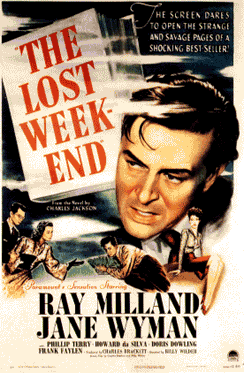
The Lost Weekend (Billy Wilder, 1945)


The Lost Weekend (Billy Wilder, 1945)
Rating: 9.9

"It shrinks my liver, doesn't it, Nat? It pickles my kidneys, yeah. But what it does to the mind? It tosses the sandbags overboard so the balloon can soar. Suddenly I'm above the ordinary. I'm competent. I'm walking a tightrope over Niagara Falls. I'm one of the great ones. I'm Michaelangelo, molding the beard of Moses. I'm Van Gogh painting pure sunlight. I'm Horowitz, playing the Emperor Concerto. I'm John Barrymore before movies got him by the throat. I'm Jesse James and his two brothers, all three of them. I'm W. Shakespeare. And out there it's not Third Avenue any longer, it's the Nile. Nat, it's the Nile and down it moves the barge of Cleopatra."

Thursday, January 18, 2007

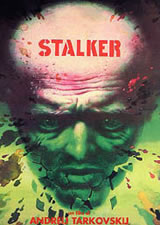
Stalker (Andrei Tarkovsky, 1979)


Stalker (Andrei Tarkovsky, 1979)
Rating: 10
"My conscience wants vegetarianism to win over the world. And my subconscious is yearning for a piece of juicy meat. But what do I want?"

Tuesday, January 16, 2007

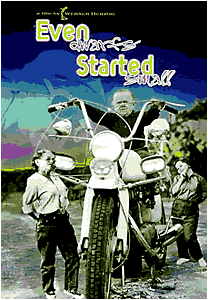
Auch Zwerge haben klein angefangen (Werner Herzog, 1970) aka Even Dwarfs Started Small


Even Dwarfs Started Small (Werner Herzog, 1970)
Rating: 9.0

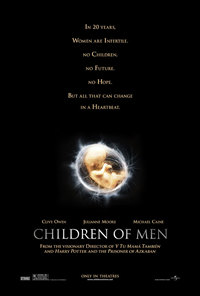
Children of Men (Alfonso Cuarón, 2006)


Children of Men (Alfonso Cuarón, 2006)
Rating: 9.0

I didn't have any real problems with the film. In fact I liked the whole concept and it had some very touching moments. It was well acted, and the cinematography and sound also worked well. I just felt that some of the dialogue was very poorly written. For example: They really tried to beat us over the head with lines about how close Clive and Julian's characters were twenty years ago. There are also some unprovoked backstory moments which always annoy me, and after it is discovered Kee is pregnant, Theo reiterates this fact not only once, but twice as if it weren't already apparent.

Wednesday, December 27, 2006

Monday, December 18, 2006

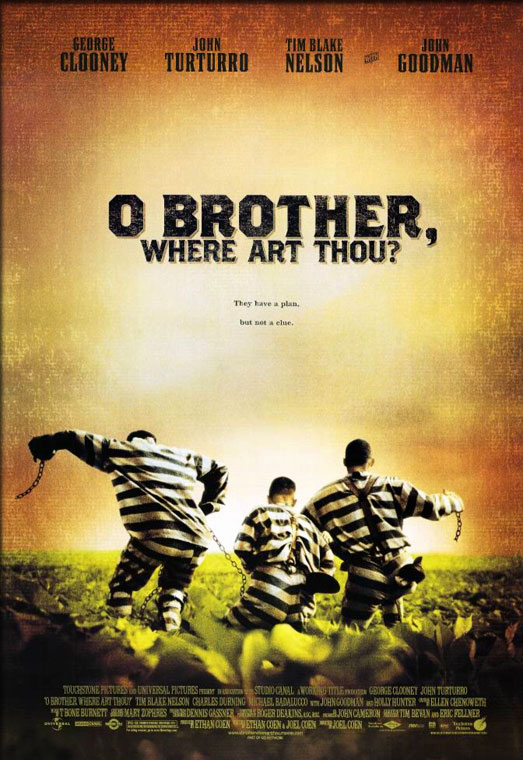
O Brother, Where Art Thou? (Joel and Ethan Coen, 2000)


O Brother, Where Art Thou? (Joel and Ethan Cohen, 2000)
Rating: 9.8

This is an amazing adaptation of the Odyssey during one of the most fascinating times in American History. The overooked details and parralles to Homer's Odyssey make in even more interesting. Blending actual historical figures and events like bluesman Tommy Johnson and George "Babyface" Nelson with folklore, mythology, southern music, culture, and politics, this film is a joy to watch.

Nashville (Robert Altman, 1975)


Nashville (Robert Altman, 1975)
Rating: 8.7

"Does Christmas smell like oranges to you?"

Saturday, December 16, 2006

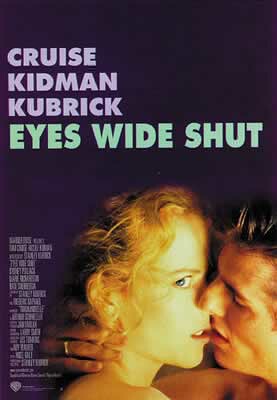
Eyes Wide Shut (Stanley Kubrick, 1999)


Eyes Wide Shut (Stanley Kubrick, 1999)
Rating: 8.2

I enjoyed the open endedness of this heart warming Christmas classic as well as the music, but everything just seemed overdone from the acting (Nicole Kidman especially, Tom Cruise did just fine), the sexuality, the constant reminders that it's Christmas time and Tom Cruise's Character is a doctor.

Friday, December 15, 2006

Experimental Video:

Still from Buckner's film Hearts


Juste le Tempe (Robert Cahen, 1983) - 6.5
Hearts (Barbara Buckner, 1979) - 9.4
Antiqua 78 RPM (Neam Cathod, 1985) - 6.6
Bird in Flight (Franklin Miller, 1984) - 8.3
I Cannot Go To Africa Because I'm on Duty (Eder Santos, 1990) - 5.5
History and Memory (Rea Tajiri, 1985) - 7.9

Minimalist-Structuralist films:

Still from Lawder's Necrology (1969)


Necrology (Standish Lawder, 1969) -10
Print Generation (J.J. Murphy, 1974) - 6.4
Pasadena Freeway Stills (Gary Beydler, 1974 - 8.8
Streamline (Chris Welsby, 1976) - 8.3
Alpha Mandala (Joseph Anderson and Edward Small, 1972) - 7.8
Kiri (Sakumi Hagiwara, 1971) - 7.8

Expanded Cinema:

A still from James Whitney's film "Lapis," that explores abstract art's relationship to music.

Allures (Jordan Belson, 1961) - 7.2
Mandala (Jordan Belson, 1952) - 7.7
Lapis (James Whitney, 1966) - 7.3
OffOn (Scott Bartlett, 1972) - 8.0
Now That the Buffalo’s Gone (Gershfield, 1967) - 8.3

Wednesday, December 06, 2006

Friday Night Lights (Peter Berg, 2004)


Friday Night Lights (Peter Berg, 2004)
Rating: 7.0

With incredible performances by Derek Luke as Boobie Miles and Tim McGraw as the drunken father of a player, and hands down the best music accompaniment to a sports film to date, Friday Night Lights takes a giant step forward for sports movies in general. Rather than being entirely banal entertainment, this film is semi poetic and touching at times. The final scene where the players names are getting removed from the roster, as well as the scenes of Boobie's struggle to realize the seriousness of his injury and his emotional response to the threat of shattered hopes are heartbreaking. I must say "semi" poetic because the film is still flawed, and there are still clichés and mainstream conventions aplenty. I was especially annoyed by the the playoff montage and the insistance on playing cheesey 80s rock music rather than sticking to Explosions in the Sky. Perhaps this isn't a cinematic masterpiece, but in comparison with some of the trivial garbage within the genre, this movie stands above most.