The directing, shot selections and overall aesthetic was rather uninteresting and anything but bold, consisting of overused dirty hand held camera work. of The score and sound design was generic horror crap, and the story and dialogue, etc. was predictable and petty. I also found it hilarious how often they would cut to inserts of the record player without much motivation behind it. Most annoying of all, was the characters irrational behaviors. Overall the film adds up to be little more than cheap thrills.
The film begins with a gorgeous time lapse shot of a bridge and a piece from a Nino Rota score before the nonlinear story intercut with consumer grade video clips of skating teenagers gets underway. Van Sant later returns to an even more beautiful time lapse scene during a storm after the most pivotal scene in the film. The film isn't short on striking imagery, but it is lacking in adequate acting. Throughout the film, the main character named Alex dictates the letter he is writing which reveals a gruesome accident he was involved in. The narration is seriously grating; it's like in grade school when kids are asked to read a passage from the textbook out loud only the material is much less articulate. I also found the gratuitous use of unmotivated slow motion shots became tedious, not to mention the over the top eclectic for the sake of it soundtrack which probably included double digit genres ranging from Beethoven, experimental/electronic, jazz, country/folk, Elliott Smith, hip-hop, opera, metal, as well as sporadic pieces of Nino Rotas scores from Amarcord and Juliette of Spirits as mentioned before. I was most impressed with the sound design for a film of such a small scale. There is some really great stuff going on during the shower scene, railroad scene, among others, but my favorite part was when Alex's internal thought process is running through his head; dialgue overlaps with different echoes and reverbs making for a great effect.
A beautiful bittersweet nostalgic film that really evokes a love for life, especially after watching so many depressing films lately. I almost want to say this is my favorite thing I've seen from Fellini. Nights of Cabiria, 8 1/2, and La dolce vita are all extraordinary films, while La Strada and Satyricon are great, but I think this one resonates with me more personally than any other.
I saw this at The Silent Theater with live music accompaniment by Ariel Pink, Plastic Crimewave and Jimi Hey. As a child, Gwynplaine has a permanent smile carved on his face by a group of gypsies. Years later he becomes a popular clown and falls in love with a blind girl named Dea, but their love is jeopardized when it is discovered he is a royal heir. The character later served as the visual inspiration for The Joker. The art direction in this film dark film was incredible. I also enjoyed the adorable apple throwing monkey and the heroic wolf dog named Homo.
A 7 hour film primarily driven by rhythm, tone, and beautiful black and white photography with many shots lasting over ten minutes in length. Scenes are also repeated throughout and displayed through perspective's of different characters.
IMDB keywords for the film include: Necrophilia Fetishism Sadomasochism Asylum Ghost Seance
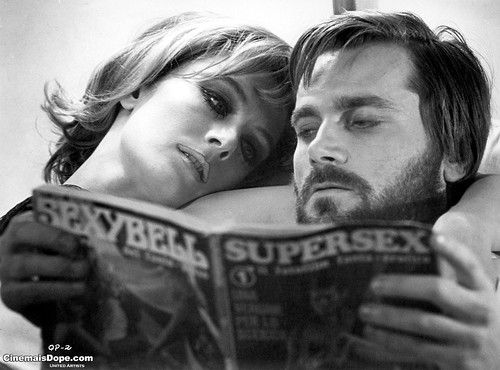
The film also boasts a pretty incredible list of talent including an original avant- garde score by Ennio Morricone, actress Vanessa Redgrave, and a story provided by the legendary Italian screenwriter Tonino Guerra whose amazing laundry list of writing credits include films for Antonioni (L'Avventura, L'Eclisse, Blowup, The Red Desert), Andy Warhol's Frankenstein, Tarkovsky's Nostalghia, as well as films for Angelopoulos (Voyage to Cythera, The Beekeeper, Landscape in the Mist, Ulysses' Gaze, Eternity and a Day, The Weeping Meadow), and many more. A Quiet Place in the Country is the story of an artist who purchases a country villa in order to escape the city and focus on his work. The film is very atmospheric and in many ways very similar to The Shining. It is also very psychedelic and surreal and even plays with dualistic ideas between realism and surrealism; Redgrave's character is labeled as the practical realist, whereas Leonardo (Franco Nero) is an eccentric painter on the brink of insanity.
[I]Twilight of the Ice Nymphs[/I] most resembles a made for television sci-fi melodrama you would likely see on late night "Skinemax." Maddin satirizes the most unappealing aesthetic style/genre in existence; one that in fact is so amusingly lame that no parody of it could ever be half as funny or entertaining. Aesthetics and parody aside this is Maddin's least interesting film narratively as well, but I suppose it would fit in nicely with the schlock The Sci-fi Channel is showing these days.
Harmony Korine's latest film about a Michael Jackson impersonator joinging a commune of other celebrity impersonators and trying to discover himself, is somewhat of a departure from his past work, showing both progression and missteps. It is also his most autobiographical picture. Returning from an 8 year hiatus, Korine litters his new film with fragments of his midlife crisis. After a very strong opening and the always exciting screen presence of Werner Herzog, the film begins to stagger with it's insistence on indiscreet voice over and dialogue along with a few audaciously cheesy scenes including a nun falling from an airplane, and surviving the fall after praying to the lord. Despite these mistakes which Harmony claims to love, the film is filled with many memorable and even gorgeous images. The soundtrack consisting of everything from original score by Spaceman and the Sun City Girls, to A Silver Mt. Zion, Spank Rock, and some old blues and folk music is one of the strongest assets. Michael's character played by Diego Luna, laments at not being able to relate to the rest of the world, seeing things differently, and wanting to be someone other than himself. He and his fellow impersonators including Marylin Monroe, played by Samantha Morton, live in a sort of dream-like reality. To parallel this rebellion, the commune raises witless sheep without the freedom of choice or nonconformity. The main goal of the commune is to build a theater and draw audiences to "share the beauty of the world" with others, although only a few lonely souls show up to watch them perform. I think this is another reflection of Korine's struggle to make his mark with his own art. Originally I felt that the more conventional narrative structure of the film was what hindered it the most, however after thinking about it a little more I think Korine is capable of successfully making a conventional narrative. Unfortunately Mister Lonely is much more overt about letting you known what it wants you to feel, as opposed to his first two features which allow for much greater personal reflection through mostly just imagery.
I'm a huge fan of Italian realism and of this pivotal film in the history of cinema. The story is very simple as it focuses on the plight of one man in need of his bicycle to work and provide for his family. Emotionally we connect and sympathize with the protagonist and the adorable relationship he has with his son Bruno, but just as importantly if not more so the film covers the broader social problems of the impoverished lower class. When Antonio and his wife sell their sheets to the pawn shop in order to buy back his bike which he had previously pawned off, we see a reveal of a man climbing a seemingly endless storage shelf full of identical bundles of sheets signifying that the Ricci family is merely an individual representation of many similar stories. Later in the film Antonio follows a poor old man into a church that is providing free meals and grooming to the poor. Initially we feel disdain towards the man because he is associated with the thief, but this scene arouses pathos. When the thief is finally confronted, we see the slums he is living in as the community comes to his aid for protection after Antonio accuses him of stealing. After Antonio becomes tries to steal a bike himself, we can begin to sympathize with the original thief or at least understand his desperation. The touching scene with the boy and his father eating an expensive lunch next to a rich family is also one of the finer moments of the film. I also admire De Sica's choice to end the film with such uncertainty.
Brakhage combines his love of French surrealism with his affinity for Italian neorealism as he captures the paranoia and claustrophobia of the beatnik generation. Accompanied by an avant-garde musical composition, Brakhage approaches his subjects with a voyeuristic and shakily wandering camera as they drink and smoke, among various other eccentric activities such as using a mandolin as a machine gun, building a book tower, and becoming tangled in a spool of thread. At times the film resembled a surreal recreation of Reefer Madness.
This is an entirely silent piece that explores a newlywed couple and their interactions seen through alternating flashes of darkness and light and shots resembling polarized pornography. Brakhage plays with the absence and presence of darkness and light as our eyes are sporadically drawn to the glimpses brightness. Real objects become abstracted by the sparse and selective lighting as we try to make sense of it all.
Named after the literal definition of "autopsy," this film cuts together actual autopsy footage shot by Brakhage himself. For thirty minutes we are confronted with death and it's physical grotesqueness face to face and in silence. The lifeless bodies of anonymous men and women are ripped open, torn apart, and moved about like lumpy masses. Gradually the film becomes more intensely graphic to the point where it became very hard for me to continue watching, but left me with many questions. Are men meant to pry into the secrets of the internal body? should the body be considered a sacred object or is it just a temporary vessel? Who were these people, and is the autopsy and our viewing of this a form of trespassing?
The technical merits far outweigh the impact of the narrative for me. I've heard some critics complain that Welles' trick shots and stylization hinder the emotional weight and I tend to agree, however it is the former which has given Citizen Kane the reputation it has today.